Lazy Eye in Children: Causes, Symptoms, and When Can It Be Treated?
What Is Lazy Eye?
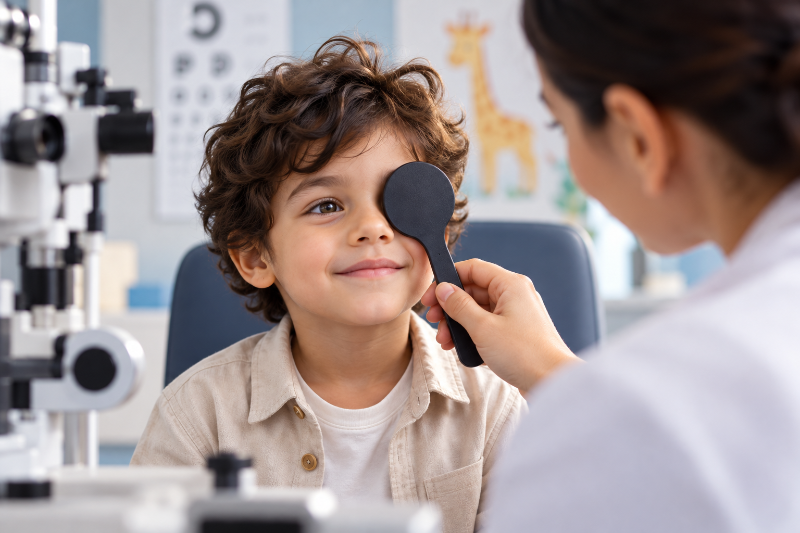
Amblyopia is reduced vision in one or both eyes because normal visual development did not occur during childhood. The eye may look normal, but the brain does not learn to rely on it properly. Over time, the brain begins to favor the eye that provides a clearer image.
If your child has strabismus, a major difference in prescription between the eyes, or a problem that prevents a clear image from reaching one eye, the brain may begin to ignore the image coming from that eye. If this continues without treatment, the reduced vision may become more permanent.
Amblyopia is not simply a minor vision problem in children that can be ignored or expected to improve on its own. It requires evaluation by an ophthalmologist to identify the cause and assess its severity.
What Causes Lazy Eye?
You may ask yourself: Why does amblyopia occur in children?
In most cases, it begins with a problem that causes one eye to produce a less clear image than the other. Common causes include:
- Strabismus: When the eyes are not aligned in the same direction, the brain may ignore the image from the misaligned eye to avoid double vision.
- Different prescriptions in the two eyes: This may include a clear difference in nearsightedness, farsightedness, or astigmatism between the eyes.
- Congenital cataract: Clouding may prevent a clear image from reaching the retina, affecting visual development.
- Other problems that block vision during childhood: These are especially significant if they are not detected and treated early.
This is why children’s eye examinations are important. A child may not even realize that vision is weaker in one eye.
How Can You Tell If Your Child Has Lazy Eye?
Your child may not report a problem because they have become accustomed to relying on the stronger eye from the beginning. You may need to watch for certain signs while they are playing, reading, or watching television.
You may notice that your child:
- Tilts their head or closes one eye when looking at objects.
- Sits very close to the television or holds a book close.
- Has difficulty judging distances or seeing details.
- Has one eye turning inward or outward.
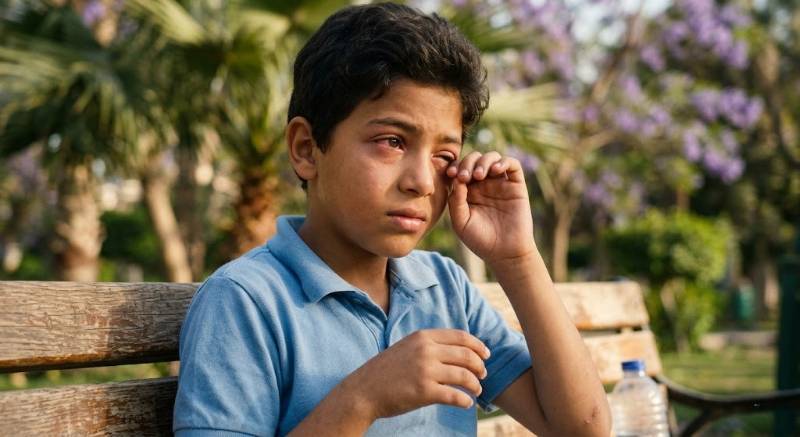
- Rubs their eyes frequently or complains of blurred vision.
- Shows a clear difference in how the two eyes perform.
However, symptoms alone are not enough to confirm amblyopia. Some children with the condition may not show obvious signs.
If you notice any change in the way your child sees, it is best to arrange a comprehensive eye examination with a pediatric ophthalmologist rather than wait for more obvious symptoms to appear.
When Is Lazy Eye Detected?
Amblyopia is usually detected through vision testing and an eye examination. The doctor compares vision in each eye, checks eye movement and alignment, and looks for refractive errors or any problem that prevents a clear image from forming.
Vision screening becomes especially important before a child starts school. A child may not be able to describe a difference between the two eyes, while early treatment is usually more effective during the development of the visual system.
Can Lazy Eye Be Treated After Childhood?
Treatment may improve vision after childhood, but the response varies from person to person. The chances of improvement are usually greater when treatment begins early.
Amblyopia treatment has long been associated with childhood because the early years play an important role in developing the visual pathways in the brain. However, some degree of neuroplasticity may continue after childhood. This means that some adults may benefit from treatment and achieve improved visual acuity.
This does not mean that vision will fully return to normal in every case. Results depend on several factors, including the patient’s age, the severity and cause of amblyopia, how long it has been present, the type of treatment, and adherence to the treatment plan.
How Is Lazy Eye Treated?
Treatment depends on the cause, the patient’s age, and the degree of reduced vision. The main goals are to treat the underlying cause and encourage the brain to use the weaker eye. Treatment options include:
- Prescription glasses
If the cause is nearsightedness, farsightedness, or astigmatism, prescription glasses may be the first step in providing a clear image to both eyes.
In some cases, vision improves once the refractive error is corrected. Other children may need additional treatment.
- Patching the stronger eye
The doctor may recommend placing a patch over the stronger eye for a specific number of hours each day. This encourages the brain to use the weaker eye.
Do not decide the number of patching hours on your own. The treatment plan varies according to the child’s age and the severity of amblyopia.
- Eye drops
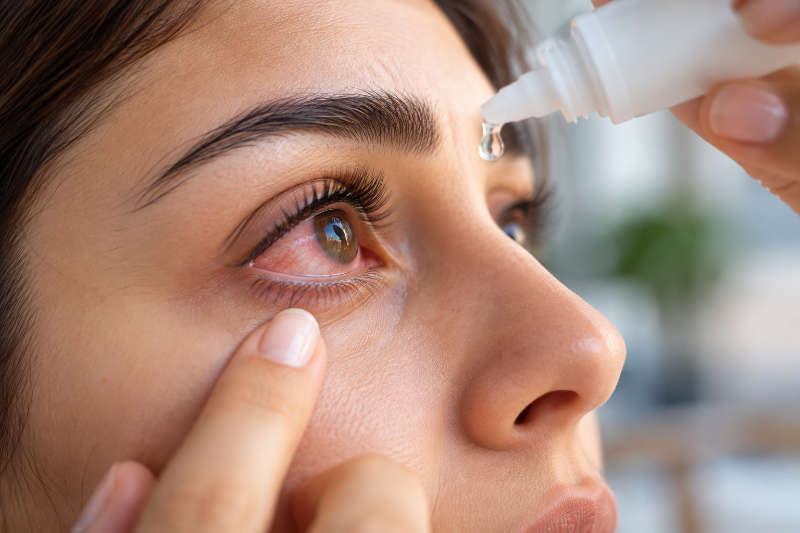
For some children, atropine drops may be used in the stronger eye to temporarily reduce its ability to focus. This encourages the child to use the weaker eye. The drops must be used under the supervision of an ophthalmologist and according to the child’s condition.
- Amblyopia exercises
Certain activities or visual exercises may be used as part of the treatment plan when the doctor considers them appropriate.
However, eye exercises alone are not suitable treatment for every case of amblyopia. Treatment depends first on identifying and correcting the cause.
- Treating strabismus or the underlying cause
If amblyopia is related to strabismus or another eye problem, the doctor may need to treat the underlying problem first or at the same time as treating amblyopia.
In some cases of strabismus, surgery may be performed to adjust the eye muscles. However, strabismus surgery does not automatically treat amblyopia itself. The patient may need additional treatment to improve vision in the weaker eye.
Can Lazy Eye Be Completely Treated in Adults?
Complete recovery from amblyopia cannot be guaranteed for all adults. However, some people may experience improved vision after appropriate evaluation and treatment.
Results vary from person to person. Doctors therefore consider more than age alone. They also assess the cause of amblyopia, the degree of reduced vision, the patient’s medical history, and how the eye responds to treatment.
When Should You See an Ophthalmologist?
If you notice that one of your eyes is weaker than the other, or you notice that your child tilts their head, closes one eye, has strabismus, or struggles to see details, do not delay an eye examination.
The earlier the cause is detected, the greater the chance of receiving timely treatment, especially in children during the years when vision is developing.
In closing, amblyopia is not simply reduced eyesight. It is a problem involving the development of vision and communication between the eye and the brain. If you notice a difference in vision between your eyes or any unusual signs in your child, do not wait for the problem to become more obvious. Early diagnosis and treatment of the cause can improve the chances of benefiting from treatment. Even in adulthood, some people may have an opportunity for improvement depending on their condition.
If you still need a doctor’s consultation regarding this condition, you can easily book an appointment through Vezeeta.
Related Keywords



References
https://www.nei.nih.gov/eye-health-information/eye-conditions-and-diseases/amblyopia-lazy-eye
https://www.mayoclinic.org/diseases-conditions/lazy-eye/symptoms-causes/syc-20352391
https://www.mayoclinic.org/diseases-conditions/lazy-eye/diagnosis-treatment/drc-20352396
https://www.nhs.uk/conditions/lazy-eye/
https://medlineplus.gov/amblyopia.html
https://health.clevelandclinic.org/when-is-it-too-late-to-treat-lazy-eye
https://www.moorfields.nhs.uk/eye-conditions/amblyopia-lazy-eye/diagnosis-and-treatment