What Causes Tooth Decay in Children’s Baby Teeth, and How Is It Treated?
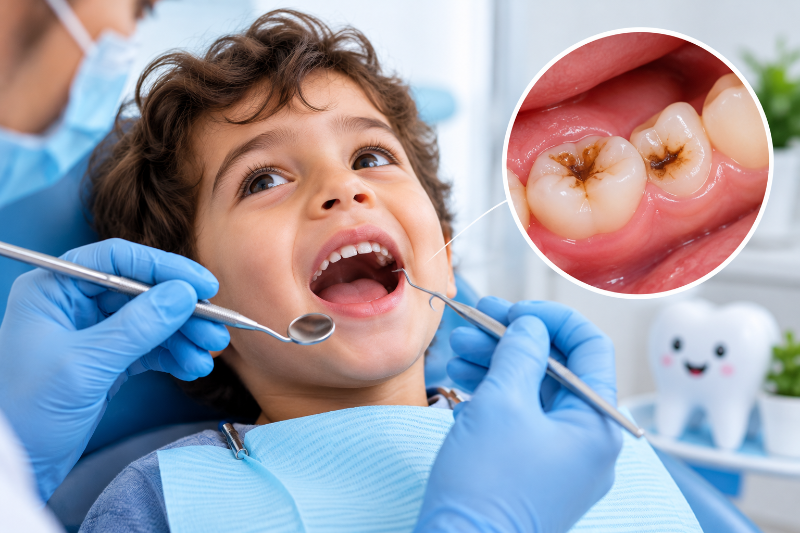
How Is Decay in Baby Teeth Treated?
Treatment depends on the extent and depth of the decay, the child’s age, and how close the tooth is to its natural time of falling out. The earlier the dentist identifies the problem, the greater the chance of preserving the tooth and avoiding pain or infection.
Treatment options for tooth decay in children include:
- Treating early decay: If white spots appear on the enamel without a cavity forming, topical fluoride may help strengthen the enamel and stop the decay from progressing. A pediatric dentist determines whether this treatment is appropriate.
- Fillings for baby teeth: When a cavity has formed, the dentist removes the decayed tissue as needed and fills the tooth with a suitable material to restore its function and protect it from further damage.
- Pulp treatment for baby teeth: If the decay reaches the dental pulp, the child may need pulp therapy or removal of part or all of the pulp, depending on the degree of inflammation and the condition of the roots.
- Extraction of a baby tooth: Extraction may be necessary if the tooth is severely damaged and cannot be preserved, or if the infection is severe and cannot be treated with another suitable method.
Decay in baby teeth does not always mean that extraction is the best solution. Preserving the natural tooth whenever possible helps the child chew normally and maintains the space needed for the permanent teeth to erupt.
Can Decay in Baby Teeth Affect the Permanent Teeth?
Yes. Advanced decay in baby teeth may affect the health of the permanent teeth, especially if it is left untreated and causes inflammation or an abscess near a developing permanent tooth.
For example, severe inflammation around the roots of a baby tooth may affect the development of the permanent tooth underneath it. In some cases, it may cause changes in the color of the permanent tooth or the shape of its enamel. These complications do not occur in every case of tooth decay.
Early loss of a baby tooth because of decay may also cause neighboring teeth to move into the empty space. This can reduce the space available for the permanent tooth to erupt. For this reason, the dentist may recommend a space maintainer in some cases, depending on the tooth involved, its expected time of falling out, and the stage of dental development.
How Can You Protect Your Child’s Permanent Teeth from Decay?
- Treat decay in baby teeth as soon as it is discovered. Do not wait for the tooth to fall out on its own.
- Clean your child’s teeth twice a day with an age-appropriate amount of fluoride toothpaste.
- Limit how often your child eats sweets or drinks sweetened beverages, especially between meals and before bedtime.
- Arrange regular visits with a pediatric dentist to detect decay early.
- Ask the dentist about topical fluoride and suitable preventive measures for your child.
When Should Baby Teeth Be Extracted?
Not every baby tooth affected by decay needs to be extracted. The dentist tries to preserve the tooth when this is possible and safe. Extraction may be recommended in situations such as:
- Advanced decay that has destroyed a large part of the tooth and prevents suitable restoration.
- Inflammation or an abscess that cannot be controlled with another appropriate treatment.
- A severe fracture that makes the tooth impossible to restore.
- Circumstances involving the expected time of tooth loss or the development of the permanent teeth that make extraction the most suitable option after the dentist’s evaluation.
After a baby tooth is extracted before its natural time of falling out, the dentist assesses whether the child needs a space maintainer to prevent neighboring teeth from moving and to preserve enough space for the permanent tooth.
See a dentist promptly if the decay is accompanied by persistent pain or gum swelling. Facial swelling with fever, or difficulty swallowing or breathing, requires urgent medical care.
When Does Decay in Baby Teeth Begin to Appear?
Decay may begin shortly after baby teeth erupt if they are repeatedly exposed to sugars and are not cleaned adequately. It may first appear as chalky white spots, then develop into brown or black spots or visible cavities as the condition progresses.
Decay affecting infants’ and young children’s teeth is sometimes called early childhood caries. It may be linked to frequent consumption of sweetened drinks or allowing a bottle containing milk or juice to remain in the child’s mouth during sleep.
How Long Does It Take for Decay to Reach the Nerve?
There is no fixed time for decay to reach the tooth nerve. The speed of progression varies according to the depth of the decay, oral hygiene, diet, and the characteristics of the tooth. Decay may progress quickly in some children, so it is not advisable to wait until pain appears because the decay may advance before the child notices any symptoms.
Can Tooth Decay Be Treated in a Two-Year-Old Child?
Yes. Tooth decay can be treated in a two-year-old child. The dentist chooses the appropriate method based on the severity of the decay, the child’s cooperation, and their health condition. Treatment may include topical fluoride for some early lesions, materials that stop the decay in selected cases, or a filling or pulp treatment if the decay is advanced.
Treatment should not be delayed simply because the child is young. Early intervention can help reduce pain, infection, and the need for more complex treatment.
What Causes Decay in the Front Baby Teeth?
Decay in the front baby teeth may result from repeated exposure to sugars, especially when a child sleeps with a bottle containing milk or juice or frequently drinks sweetened beverages. Inadequate cleaning with fluoride toothpaste increases the risk.
To prevent it, clean your child’s teeth as soon as the first tooth appears, avoid putting the child to bed with a bottle containing sweetened drinks, limit how often the child consumes sugars, and schedule regular visits with a pediatric dentist.
In brief, treatment for decay in baby teeth varies according to its severity. Some early cases may require only fluoride, while other cases may need a filling, pulp treatment, or extraction. Do not wait until your child complains of pain or the teeth begin to break down. Early dental examination and daily oral care can reduce complications, maintain oral health, and preserve the space needed for the permanent teeth to erupt.
If you still need a doctor’s consultation regarding this condition, you can easily book an appointment through Vezeeta.
Related Keywords

Specialized Doctors

Heba Hassan Hadhoud
Specialist in oral and dental medicine, implants, root canal treatment, gum implants and surgeries, and dental plastic surgery

Mostafa Elkhashab
Dental implants and cosmetic dentistry

Mohamed Farag
Oral surgeon & Implantologist
References
https://www.cdc.gov/oral-health/prevention/oral-health-tips-for-children.html
https://medlineplus.gov/ency/patientinstructions/000721.htm
https://www.nhs.uk/baby/babys-development/teething/looking-after-your-babys-teeth/
https://www.mouthhealthy.org/all-topics-a-z/baby-teeth
https://www.mouthhealthy.org/all-topics-a-z/space-maintainers
https://my.clevelandclinic.org/health/treatments/pulpotomy
https://www.mayoclinic.org/diseases-conditions/cavities/diagnosis-treatment/drc-20352898
Specialized Doctors
Heba Hassan Hadhoud
Specialist in oral and dental medicine, implants, root canal treatment, gum implants and surgeries, and dental plastic surgery
Mostafa Elkhashab
Dental implants and cosmetic dentistry
Mohamed Farag
Oral surgeon & Implantologist