Status asthmaticus
Description
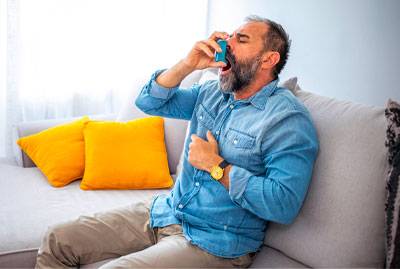
Status asthmaticus is a severe form of asthma that doesn’t respond to normal medications and is considered a medical emergency that needs immediate treatment.
Asthma affects 7.8% of the world population, and women are more likely to develop severe asthma.
There are two types of status asthmaticus which are :
- Slow onset asthma exacerbation : It develops over days and usually has predisposing factors such as patient non-compliance.
- Sudden onset asthma exacerbation : It presents with deterioration within hours, and it usually happens in response to triggers such as allergens.
Symptoms
The patient suffers from :
- Wheezing, coughing, and chest tightness becoming severe and constant
- Being too breathless to eat, speak or sleep
- Faster breathing
- Faster heart beats
- Drowsiness, confusion, exhaustion, or dizziness
- Blue lips or fingers
- Fainting
If you experienced these symptoms and it’s not getting better by usual relievers call the ambulance or go to the emergency department
Recommended Doctors
View MoreCauses
There are several risk factors for this severe exacerbation :
- Viral respiratory infections-this is considered a major cause
- Medical non-compliance
- Exposure to allergens (especially pets and molds) in severely allergic patients
- Irritants inhalation (Such as smoke and paint)
- Stress
Diagnostics
The following tests can be used in addition to physical examination :
Peak flow/forced expiratory volume : These are tests used to measure airway obstruction.
Pulse oximetry : A device is used to measure the oxygen saturation before supplying the patient with oxygen.
Arterial blood gases : This is used to measure the level of blood gases such as oxygen and carbon dioxide.
Other tests should be used according to the patient's situation such as Complete blood cell count with differential, chest radiograph, echocardiogram, and electrolytes.
Treatment
There are different types of medications that can be administered :
- Salbutamol : This is the first line of treatment, and it can be combined with a medication called ipratropium.
- Corticosteroids : These can be oral or intravenous, but intravenous is the preferred one to be used. (ex : Hydrocortisone sodium succinate, Methylprednisolone, Prednisolone).
- Other medications : These include Magnesium sulfate, Heliox, Theophylline, and Aminophylline.
Other treatments :
- Supplemental oxygen
- Correction of dehydration
- Anti-influenza therapy in high-risk patients
- Agnihotri NT, Saltoun C. Acute severe asthma (status asthmaticus). Allergy Asthma Proc. 2019;40(6):406-409.
- Most Recent National Asthma Data. CDC. Available at : https://www.cdc.gov/asthma/most_recent_national_asthma_data.htm. Last accessed at: 15/9/2022.
- Chowdhury NU, Guntur VP, Newcomb DC, Wechsler ME. Sex and gender in asthma. Eur Respir Rev. 2021;30(162):210067.
- Chakraborty RK, Basnet S. Status Asthmaticus. [Updated 2022 Apr 22]. In: StatPearls [Internet]. Treasure Island (FL): StatPearls Publishing; 2022 Jan-. Available from : https://www.ncbi.nlm.nih.gov/books/NBK526070/. Last accessed at: 15/9/2022.
- Asthma. NHS. Available at: https://www.nhs.uk/conditions/asthma/symptoms/. Last accessed at : 15/9/2022.