What Is Multiple Sclerosis? Its Symptoms and Treatment
Hope remains alive in the search for an effective cure for multiple sclerosis (MS)—a disease that has hindered many from living normal lives. Recently, numerous studies have focused on finding treatments that not only manage flare-ups and slow disease progression but also target a complete cure.
Join us in this journey to understand what MS is, its causes, symptoms, and the latest scientific advances in treating it.
What is Multiple Sclerosis?
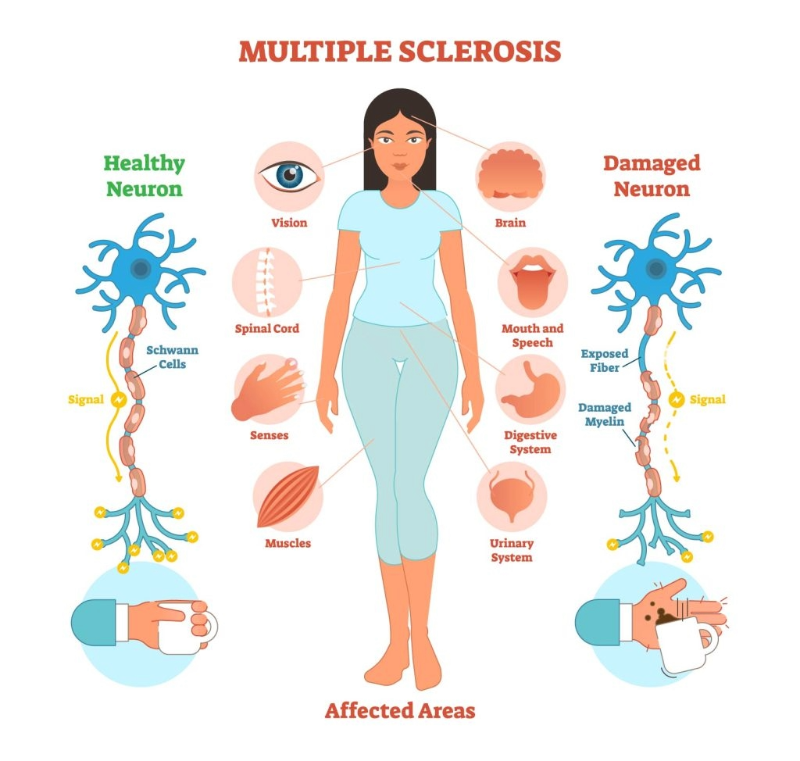
Multiple sclerosis (MS) is an autoimmune disease in which the immune system mistakenly attacks the myelin sheath—the protective covering of nerve fibers. This sheath is vital for transmitting nerve signals between the brain and the rest of the body. Damage to it disrupts these signals.
People with MS often experience symptoms like visual disturbances, balance issues, and muscle weakness.
What are Symptoms of Multiple Sclerosis?
MS symptoms vary depending on which nerves are affected and how advanced the disease is. Vision problems are often the first symptoms, including:
- Blurred or double vision
- Eye pain when moving the eyes
- Partial or total vision loss, usually in one eye at a time
Other common symptoms in both men and women include:
- Numbness in the limbs
- Muscle weakness and extreme fatigue
- Loss of balance and coordination
- Muscle spasms
- Dizziness
- Muscle stiffness
- Difficulty controlling muscles, especially the bladder
- Bowel dysfunction
- Gradual memory decline
- Trouble speaking or thinking clearly
What are MS Relapse Symptoms?
A relapse (or flare-up) involves new or worsening symptoms that last at least 24 hours without a clear trigger. These may include:
- Vision problems
- Bladder issues
- Dizziness
- Severe numbness
- Loss of balance
What are Types of Multiple Sclerosis?
MS is classified into several types:
- Relapsing-remitting MS (RRMS): The most common form, characterized by cycles of flare-ups followed by periods of remission.
- Primary-progressive MS (PPMS): About 10% of patients have this type, where symptoms worsen gradually with no remission phases.
- Secondary-progressive MS (SPMS): RRMS can evolve into SPMS, where symptoms worsen over time without full recovery after relapses.
- Clinically isolated syndrome (CIS): A single episode of MS-like symptoms that may or may not develop into MS.
What are Causes of Multiple Sclerosis?
MS is caused by the immune system attacking nerve fiber coverings, leading to disrupted nerve signaling.
Although the exact cause is still unknown, several risk factors have been identified:
- Family history of MS
- Women are 2–3 times more likely to develop MS than men
- Most common between ages 20–40
- People living in Northern Europe or regions far from the equator (due to less sunlight and vitamin D deficiency)
- Smoking
- Obesity
- Certain genetic mutations
- Low vitamin D levels
- Other autoimmune disorders (e.g., thyroid disease, psoriasis)
- Past viral infections (especially Epstein-Barr virus)
How Is MS Diagnosed?
There is no single test for MS. Most diagnostic procedures aim to rule out other conditions.
A doctor will conduct a comprehensive exam to assess vision, awareness, balance, and movement. They may also order:
- MRI scans to detect lesions or damage
- Blood tests to exclude other disorders
- Evoked potential tests to measure brain responses to sensory stimuli
- Spinal fluid analysis
MS is diagnosed when:
- The patient has had at least two separate attacks one month apart
- Myelin damage is found in more than one area of the central nervous system
- No other explanation is found
Can MS Be Cured?
Currently, there's no permanent cure for MS. Treatment focuses on relieving symptoms, slowing disease progression, and preventing relapses.
While treatment options were once limited, continuous research has led to over 20 approved drugs that help manage MS. However, there's still no definitive “best” treatment that suits every patient.
What is the MS Treatment in Past and Present?
MS treatment focuses on:
- Managing relapses: Previously, treatment involved using steroids to control acute flare-ups and reduce inflammation.
- Disease-modifying therapies (DMTs): These slow disease progression and prevent new brain and spinal cord lesions.
- Plasma exchange (plasmapheresis): Removes harmful proteins from plasma and replaces them to reduce immune attacks.
- Rehabilitation: Supports physical activity, improves quality of life, and provides psychological support.
What are Disease-Modifying Therapies (DMTs)?
The first DMT was introduced in 1993, and many more have since emerged to slow MS progression.
Dr. Emmanuelle Waubant, Professor of Neurology at the University of California, stated in a 2023 conference that there are now over 25 treatments to prevent MS progression. Pharmaceutical companies continue to enhance these therapies for better results.
While DMTs are effective in early MS, they are less effective in later, progressive stages.
What are Common MS Medications?
MS drugs come in different forms and vary in effectiveness. These include:
- Interferons: The first DMTs; injected into muscle or under skin to reduce inflammation
- Ofatumumab: Targets B cells to prevent new brain lesions
- Glatiramer acetate: Reduces relapse rate
- Ponesimod
- Natalizumab
- Alemtuzumab
- Ozanimod
- Cladribine
- Fingolimod
What Are the Goals of New MS Treatments?
While older treatments only focused on reducing relapses, new approaches aim higher:
- Stop MS progression
- Reverse symptoms and nerve damage through myelin repair and neurorehabilitation
- Eliminate MS entirely by reducing risk factors and preventing new cases
New Advances in MS Treatment
Here are promising therapies that may revolutionize MS care:
1. BTK Enzyme Inhibitors
- A new class targeting relapsing and progressive MS
- They suppress B-cell receptor signaling to reduce immune attacks
- Still under clinical trials
2. Stem Cell Therapy
Aims to retrain the immune system through:
- Hematopoietic stem cell transplant (HSCT): Reboots the immune response
- Mesenchymal stem cells: Anti-inflammatory and protective; extracted from the patient, modified, and reinfused
3. Ibudilast
- Still experimental
- Inhibits phosphodiesterase enzyme
- Shows promise in:
- Slowing brain lesion development
- Repairing myelin sheaths
- Protecting neurons
4. Other Experimental Drugs
- CD40 Ligand inhibitors (reduce inflammation)
- N-acetylcysteine
- Rituximab
- Simvastatin
Is MS Dangerous?
Many patients ask: What is the end result of MS?
Yes, MS can cause serious complications, including:
- Bowel and bladder dysfunction
- Psychological disorders (depression, anxiety)
- Memory problems
- Speech difficulties
- Loss of mobility
- Muscle stiffness or spasms
Final Thoughts
Modern therapies offer hope and a lifeline to MS patients. The future shines brighter for those affected, thanks to persistent scientific progress. As long as research continues, a definitive cure is only a matter of time.
If you still need to consult a doctor regarding this condition, you can easily book an appointment through Vezeeta
Related Keywords
Specialized Doctors

Randa Sedek Abdellatif
Consultant of Allergy and Immunology, Faculty of Medicine, Zagazig University

Nissreen ElSayed ElBadawy
Consultant of Allergy and Immunology, Faculty of Medicine, Zagazig University

Amal Mohamed Habib
consultant of Allergy
References
National Multiple Sclerosis Society (NMSS). What is multiple sclerosis?
Retrieved from: https://www.nationalmssociety.org/What-is-MS
Mayo Clinic. Multiple sclerosis – Symptoms and causes.
Retrieved from: https://www.mayoclinic.org/diseases-conditions/multiple-sclerosis/symptoms-causes/syc-20350269
World Health Organization (WHO). Multiple sclerosis.
Retrieved from: https://www.who.int/news-room/fact-sheets/detail/multiple-sclerosis
Compston, A., & Coles, A. (2008). Multiple sclerosis. The Lancet, 372(9648), 1502–1517.
Retrieved from: https://pubmed.ncbi.nlm.nih.gov/18707916/
National Institute of Neurological Disorders and Stroke (NINDS). Multiple sclerosis information page.
Retrieved from: https://www.ninds.nih.gov/health-information/disorders/multiple-sclerosis
Specialized Doctors
Randa Sedek Abdellatif
Consultant of Allergy and Immunology, Faculty of Medicine, Zagazig University
Nissreen ElSayed ElBadawy
Consultant of Allergy and Immunology, Faculty of Medicine, Zagazig University
Amal Mohamed Habib
consultant of Allergy