Does Diabetic Retinopathy Affect All People with Diabetes?
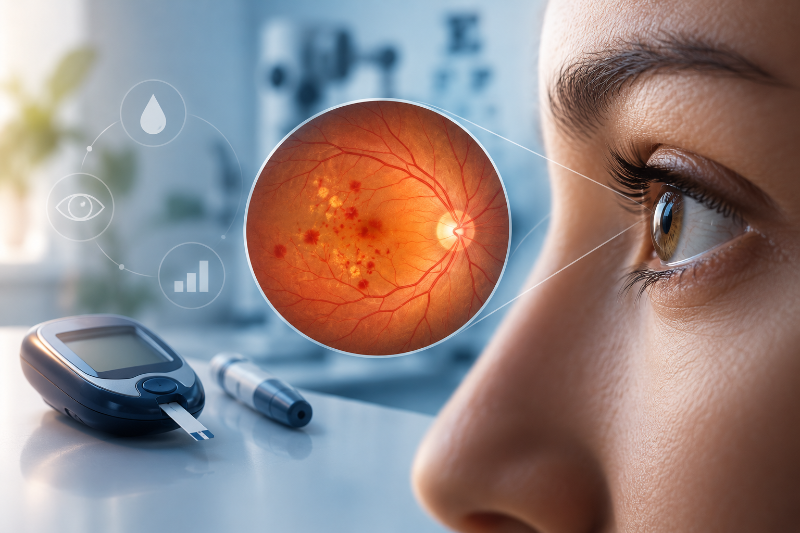
What Is Diabetic Retinopathy?
Think of the retina as the camera at the back of your eye. It captures images and sends them to the brain. To do its job, it relies on a very fine network of blood vessels that deliver oxygen and nutrients.
When blood sugar stays high for a long time, the walls of those tiny vessels start to weaken. Some leak fluid or blood. Others get blocked, which means parts of the retina stop getting the oxygen they need.
As this continues, the eye tries to compensate by growing new blood vessels. The problem? These new vessels are fragile and abnormal, so they bleed easily. That whole cascade of changes is what doctors call diabetic retinopathy. It often develops gradually, with no obvious symptoms in the beginning.
How Does Diabetes Affect the Eye?
Diabetes doesn't just target the retina. It can also raise the risk of other eye problems. But retinopathy remains one of the most important reasons people with diabetes need regular eye checkups.
The longer blood sugar stays elevated, the higher the risk of retinal damage, especially when blood pressure and other risk factors aren't well controlled either.
So the real question isn't just: can diabetes weaken your eyesight?
It's: how can you catch the damage before it reaches a stage that threatens your vision?
Can Diabetes Cause Blindness?
Yes. Advanced diabetic retinopathy can lead to severe vision loss, and in untreated cases, it can cause blindness. But here's the reassuring part: losing your sight is not an inevitable consequence of having diabetes.
Early detection, good blood sugar and blood pressure control, keeping up with eye exams, and getting treatment when needed can all significantly lower the risk of vision loss and help preserve your sight for as long as possible.
Put simply: diabetes can threaten your vision, but catching complications early can make a big difference.
What Are the Stages of Diabetic Retinopathy?
Retinal damage doesn't usually happen overnight. It progresses through stages, and understanding those stages explains why eye exams matter for people with diabetes, even when everything feels fine.
Non-Proliferative Diabetic Retinopathy (NPDR)
This is the early stage.
The small blood vessels in the retina begin to weaken. Tiny bulges, areas of blockage, and fluid or blood leakage may appear. In some cases, the leaked fluid reaches the macula (the area responsible for sharp central vision), causing it to swell and making vision blurry.
What's striking here is that the patient might not feel anything at all in the beginning. Clear vision alone is not proof that the retina is healthy.
Proliferative Diabetic Retinopathy (PDR)
As the disease advances and more blood vessels get blocked, parts of the retina may not receive enough oxygen.
The eye responds by growing new blood vessels to try to fill the gap. But these vessels are weak. They can bleed into the vitreous (the gel-like substance inside the eye), and scar tissue can form and pull on the retina. In severe cases, this can cause retinal detachment and serious vision loss.
What Are the Symptoms of Diabetic Retinopathy?
At first? Nothing. And that's exactly what makes this condition so dangerous. Changes inside the retina can be underway long before the patient notices any problem with their vision.
As the condition progresses, symptoms may include:
- Blurry or hazy vision
- Dark spots, dots, or floating threads in the field of vision
- Vision clarity that fluctuates from one day to the next
- Difficulty seeing colors clearly
- Dark or blank patches in the visual field
- Weakened vision, particularly if bleeding occurs inside the eye
If you suddenly see a large number of floaters, flashes of light, or something like a curtain or shadow covering part of your vision, that calls for urgent medical evaluation. These signs can point to serious retinal complications.
How Is Diabetic Retinopathy Diagnosed?
Early symptoms rarely give the problem away, so diagnosis depends on a dilated eye exam and a fundoscopy. The doctor may also need additional tests to evaluate the blood vessels, the retina, and the center of vision.
The eye specialist decides which tests are appropriate based on the patient's condition and disease stage.
This is why people with diabetes shouldn't wait until their vision gets worse before seeing an ophthalmologist. Routine exams can pick up changes before they noticeably affect sight.
How Is Diabetic Retinopathy Treated?
Treatment depends on the stage, where in the eye the damage is, and whether there's swelling at the center of vision, bleeding, or abnormal blood vessels.
A treatment plan may include:
- Tight blood sugar control
- Managing blood pressure and other risk factors
- Injections into the eye
- Laser treatment
- Surgery in advanced cases
The goal isn't just to improve vision. It's also to slow or stop the disease from progressing and to preserve whatever sight remains.
Eye Injections for Diabetic Retinopathy
A doctor may recommend eye injections when there's swelling in the center of vision or abnormal blood vessel growth.
The most widely used medications are Anti-VEGF drugs. They work by blocking a growth factor that drives the formation of abnormal vessels and increases fluid leakage.
The drug is injected into the vitreous of the eye using a precise technique under local anesthesia. Most patients need several sessions, depending on how they respond. In some cases, doctors may use corticosteroids instead, based on their clinical judgment.
Laser Treatment for Diabetic Retinopathy
The term "retinal laser" sounds intimidating, but it's been used for years to treat certain forms of diabetic retinopathy.
The treatment works by directing precise laser pulses at specific areas of the retina. Depending on the type and stage of the condition, the goal is either to reduce fluid leakage or to limit the growth of abnormal blood vessels.
It usually doesn't require a hospital stay, but the patient may need more than one session. Side effects vary depending on the area treated and the severity of the case.
When Does a Person with Diabetes Need Retinal Surgery?
In advanced cases, significant bleeding may occur inside the vitreous, or scar tissue may form and affect the retina.
When that happens, the patient may need a vitrectomy to remove the blood or tissue that's blocking vision or pulling on the retina.
The ophthalmologist determines whether surgery is needed based on the type of complications and how much they're affecting sight.
Can Diabetic Retinopathy Be Cured?
That depends on the stage of the disease and the kind of damage the retina has sustained.
Available treatments can help stop or slow the progression of retinopathy, reduce swelling or bleeding, and protect remaining vision. But severe retinal damage or the loss of certain nerve cells may not be fully reversible.
So don't wait for strong symptoms to show up. The earlier changes are detected, the better the chance of stepping in before permanent vision loss occurs.
How Can You Prevent Diabetic Retinopathy?
Protecting your eyesight might sound like a complicated task, but it starts with basic steps that can make a real difference:
- Keep blood sugar levels within the range your doctor sets
- Monitor blood pressure and treat it if it's high
- Get regular fundoscopy exams and any other tests your ophthalmologist recommends
- Stick to your diabetes medications and don't stop them without consulting your doctor
- Tell your eye doctor that you have diabetes, how long you've had it, and what treatments you're on
- See a doctor quickly if you notice any sudden change in your vision
And the most important thing to remember: just because your eyes feel fine doesn't necessarily mean your retina is healthy.
You may not feel any symptoms at first, but diabetic retinopathy can quietly progress and affect your vision if it's not monitored and treated. Controlling blood sugar and blood pressure, combined with regular eye exams, helps protect the retina and reduce the risk of vision loss. And remember: catching any change in your vision early gives you a better chance of keeping your eyes healthy.
If you still need a doctor’s consultation regarding this condition, you can easily book an appointment through Vezeeta.
Related Keywords


Specialized Doctors

Maha Assem
Professor of Internal Medicine , Endocrinology and Diabetology

Mohamed Hassan
Consultant in general internal medicine, diabetes, endocrinology and digestive system diseases - Ain Shams Medicine

Amal Nada
Professor And Senior Consultant For Diabetes And Endocrinology At The Faculty Of Medicine/Fellow of the Royal College of Physicians in Ednera - holds a British certificate in Endocrinology and Diabetes
References
https://www.nei.nih.gov/eye-health-information/eye-conditions-and-diseases/diabetic-retinopathy
https://www.mayoclinic.org/diseases-conditions/diabetic-retinopathy/symptoms-causes/syc-20371611
https://my.clevelandclinic.org/health/diseases/8591-diabetic-retinopathy
https://www.nhs.uk/conditions/diabetic-retinopathy/
https://www.who.int/europe/publications/i/item/9789289055321
https://www.nice.org.uk/guidance/NG242/chapter/context
Specialized Doctors
Maha Assem
Professor of Internal Medicine , Endocrinology and Diabetology
Mohamed Hassan
Consultant in general internal medicine, diabetes, endocrinology and digestive system diseases - Ain Shams Medicine
Amal Nada
Professor And Senior Consultant For Diabetes And Endocrinology At The Faculty Of Medicine/Fellow of the Royal College of Physicians in Ednera - holds a British certificate in Endocrinology and Diabetes